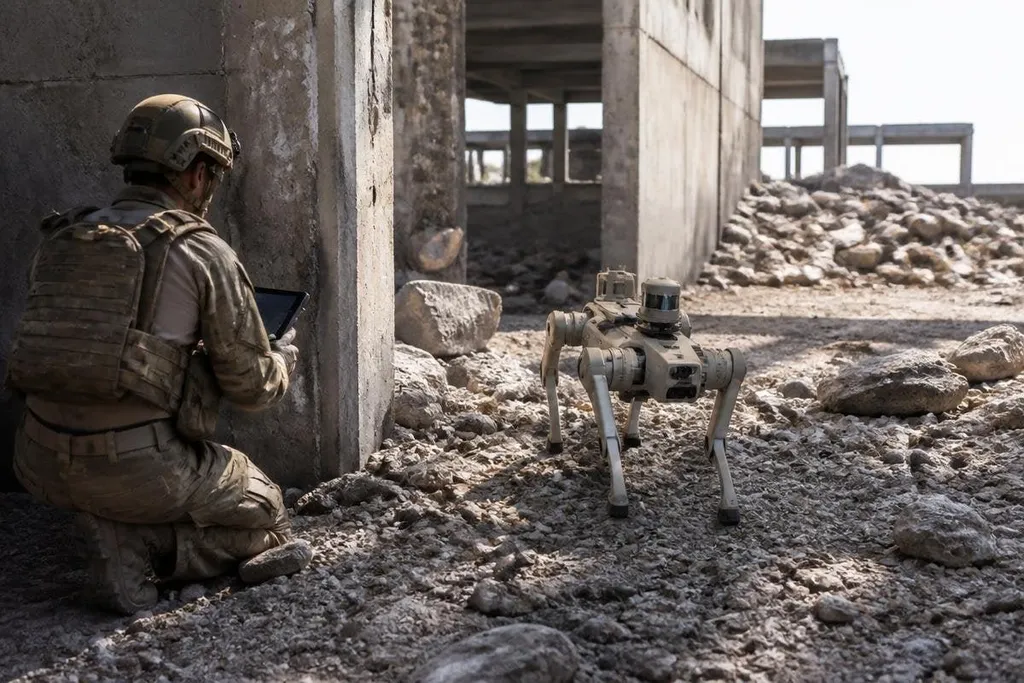
The next useful military robots won't be judged by a dramatic demo. They’ll be judged by how well they move supplies, gather information, and keep working when GPS, radio links, or batteries cause trouble.
- Autonomous movement matters most where people face danger.
- Logistics robots may reach useful service before armed systems do.
- Human control, repair time, and clear limits will decide adoption.
Robots that work without GPS
A robot that can move through a damaged building or rough ground without GPS could help soldiers inspect places that are unsafe for people. The main tools are cameras, LiDAR, inertial sensors, and software that builds a map while the robot moves.
That work is hard because dust can block cameras, smoke can confuse sensors, and walls can weaken radio signals. A system that works in a clean test area may stop when the floor changes, the lights fail, or another vehicle blocks its view.
The useful test is repeatable movement under poor conditions. Watch for a robot that can stop safely, report its location, and return to a known point after losing its link. A video showing one successful run tells you less than a record of failed runs and recovery time.
Uncrewed vehicles for supply work
Moving food, water, batteries, and medical gear is a clear use for ground and aerial robots. These missions follow set routes, carry known loads, and give human crews a way to stay farther from danger.
The hard part is not carrying a load once. It is handling slopes, mud, damaged roads, tight turns, and long waits without a technician beside the vehicle. Battery swaps, tire or track repairs, and weather limits matter as much as the motor.
A useful report should name the payload, range, travel speed, battery time, and time needed to repair the vehicle. Without those numbers, “autonomous logistics” describes an idea rather than a working system.
A sensing robot needs more than a clear video. Its report should name the sensor, detection range, control link, test site, and date. Reports from Robot 24 can connect those details to military trials before the next section looks at why sensing systems may reach units before armed machines.
Sensing robots will arrive before armed robots
Small robots with thermal cameras, microphones, or chemical sensors can gather information without sending a person into a dangerous area. Their value depends on the quality of the data and the time needed to get it back to a human operator.
A thermal camera may find a warm vehicle at night, but that image still needs context. A human must decide if the object matters, if the sensor is confused by heat from a building, and what action is safe. The robot can collect evidence; it should not quietly turn uncertain data into a decision.
This is where software rules matter. A useful system should show the sensor source, time, location, and confidence level for each alert. It should also keep a record that lets an operator review what the robot saw before the alert appeared.
Human control will set the limit
Armed autonomy will draw the most attention, but control rules will matter more than movement demos. People need a clear way to approve, stop, or redirect a robot, even when the network is slow or damaged.
That requires tested radio links, local stop controls, access logs, and software that fails in a known way. A robot that loses contact should stop, return, or follow a preset route. The choice depends on the mission, but the result must be predictable.
The open question is how much independence military units will accept after a system makes a wrong call. A fast robot that needs constant correction may create more work than it removes.
A practical watch list
Use these checks when a new military robot appears in a test or contract announcement:
- Mission first: Identify the task, such as supply movement, scouting, casualty evacuation, or route inspection.
- Numbers next: Look for payload, range, speed, battery time, sensor type, and repair time.
- Bad conditions: Check tests involving dust, rain, smoke, broken ground, weak signals, or lost GPS.
- Human role: Find out who approves actions and how an operator stops the system.
- Failure record: Ask how often the robot stopped, needed help, lost its link, or returned to base.
- Field path: Look for a named test site, unit, trial period, or delivery plan rather than a concept video.
The biggest breakthroughs will be quiet ones: a supply robot that needs fewer repairs, a scout that keeps mapping after a signal loss, or a sensor system that gives people better evidence without making the decision for them.
Until a program publishes those results, the right label is unproven, not ready.